Optimism. Pessimism. Life in a Glass.

Opening Story 📖
Optimism.

Pessimism.
Two words that have been rolling around in my mind for the past couple of days.
It all started in a group chat. I told someone to “be optimistic” about something — you know, the usual pep-talk thing we all do. And the reply came back:
I couldn’t help myself but, laugh so hard when I read it. Because the truth is… even though I was the one preaching optimism, I knew exactly how real that response was.
We all try to be optimistic, don’t we?
And then shit happens. And suddenly optimism doesn’t even feel like a choice anymore.
At that point, we don’t crave something amazing or terrible.
We just want something “decent.” “Nice.” “Not bad.” Something that basically just… works.
And when optimism stops feeling realistic, slipping into pessimism becomes the most obvious thing in the world.
And that’s when my brain took me straight to the classic “half full or half empty” argument we’ve all heard.
Classic Theory: 🥛
You’ve seen it before — the viral “glass of water” question that’s made rounds on social media.
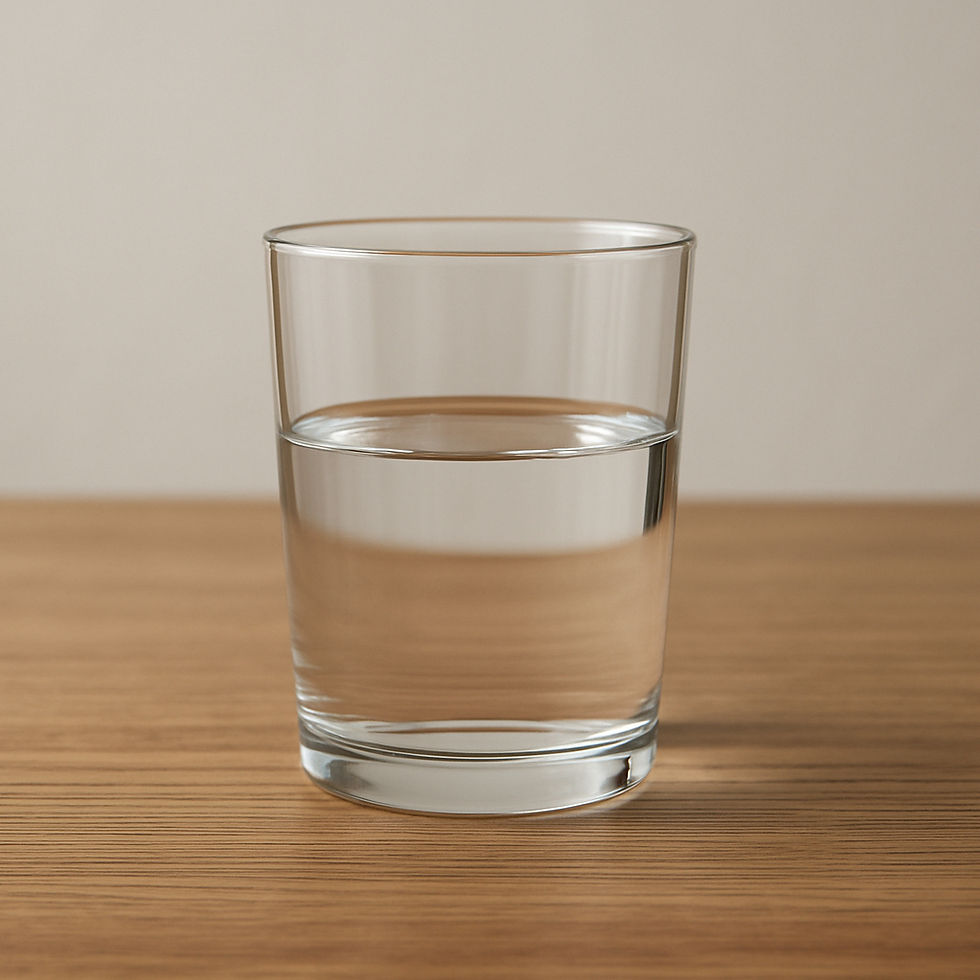
You see a glass on the table.
It’s filled halfway.
Do you see it as half full, or half empty?
It’s simple, but revealing. It’s never really about the water — it’s about perspective:
Half full: You’re an optimist — you notice what’s there, what’s good, what’s possible.
Half empty: You’re a pessimist — you notice what’s missing, what could go wrong, what’s lacking.
Realist: “The glass is full — half water, half air.” Just facts, no spin.
From there, thinkers, authors, and speakers started putting their own spins on it. Some said the question itself was flawed. Some said it depends on who’s holding the glass. Suddenly, the same half-filled glass carried a thousand interpretations.
But of course, I started thinking about it in my own way.
A Little About Me 👱🏻♀️
I really like breaking down things, no matter the context — silly or serious. I take my sweet time understanding how to respond, rather than letting my emotional brain hijack my reaction while my thinking brain is still processing and figuring out something that actually makes sense — to me, and to the world(if necessary).
This little pause doesn’t just help me make sense of situations; it has quietly changed how I respond to so many moments in life.
So when I thought about the “half-full or half-empty” theory, I started mapping it onto life: through what lens am I viewing it?
Not a straightforward question, this is. Is it?
Then came the bigger question:
What is life? 💭
For me,
Life is an amalgamation of three things — health, wealth, and relationships.

Each one fills our metaphorical glass differently.
Let’s take three scenarios here, shall we?
Here’s how each piece plays out when you look at life through this lens.
Life as Glass, Water as Health
If life is the glass, and health is water.
As we age, some of that water evaporates — health shifts, energy dips, and time shows its face.
But we can slow that evaporation with small choices: eat well, move often, rest deeply.
We can’t stop time, but we can steady the glass. Healthy habits buy us time — keeping things calm, balanced, and stable enough to enjoy the ride.
Life as Glass, Water as Wealth
Now think of life as a glass, and wealth as the water inside… except the water’s boiling.

Some of it evaporates before you even notice.
Some splashes out if you grab too fast.
And yes, sometimes it bubbles over — just for the drama.
You can’t hoard it, and staring at it won’t make it behave.
The trick?
Pour slowly. Be patient. Share mindfully.
A little patience, a little daring, and a lot of common sense goes a long way.
Money doesn’t define the glass — it just shows how steady your hands are.
Because even a full glass doesn’t last forever. The goal isn’t control — it’s calm handling, and maybe letting someone else take a sip when they need it.
Life as Glass, Relationships as Water
Think of life as a glass, and relationships — partners, family, friends — as one big chunky ice cube you drop into it.

Not the basic ice from your freezer.
I mean the chunky whisky-on-the-rocks ice that melts with discipline.
And here’s the thing:
When that ice drops in, the water rises.
If it’s too big, it overflows.
Relationships do that — they expand, cool, and sometimes shake our balance.
But when they melt, they become part of us.
That’s relationships — they add volume, value, meaning… but you have to be mindful of what you’re adding and why.
That transformation — ice into water — takes effort, patience, and warmth.
It’s the kind of change that doesn’t just add to our glass; it reshapes it.
Some people bring calm. Some bring overflow. And some dissolve so seamlessly, you forget where they end and you begin.
Bringing it all together 🌿
In the end, it’s never just about the glass or the water; it’s about how we choose to hold it, refill it, and live with whatever level it’s at in this moment. From health that needs steady tending, to wealth that rises and falls, to relationships that slowly melt into who we are, each one changes the shape and weight of our glass in its own way. The question isn’t only whether it’s half full or half empty, but whether we’re paying attention to what’s inside, how it’s shifting, and who we’re becoming as we carry it.
So, what’s your take on the half-full, half-empty theory? Are you watching the water, the glass, the ice, or maybe just noticing that you’re thirsty?
Drop your thoughts in the comments — I’d love to hear your perspective.

Comments